
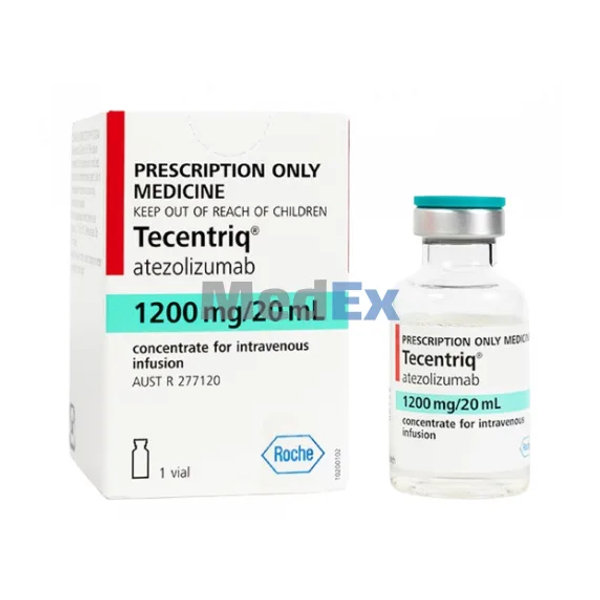
Tecentriq
 Generic: Atezolizumab
 Daily Dose:
 Course Duration:
Cheaper & Alternative Brands (1200 mg/20 ml)
Same active generic (Atezolizumab), same form (IV Infusion), exact same strength (1200 mg/20 ml)No other brands currently registered with this exact active generic and dosage form.
Clinical Prescribing Information
Medical monograph and safety information for healthcare professionals & patients.Indications & Clinical Uses
Tecentriq is indicated for the treatment of patients with locally advanced or metastatic urothelial carcinoma (UC):
After prior chemotherapy, or
Who are considered cisplatin ineligibleand whose tumours have a PD-L1 expression ≥ 5%, or
Who are not eligible for any platinum-containing chemotherapy regardless of level of tumor PD-L1 expression.
Tecentriq is indicated for the treatment of patients with locally advanced or metastatic non-small cell lung cancer NSCLC after prior chemotherapy.
Dosage & Administration
General
: Atezolizumab must be administered as an intravenousinfusion under the supervision of a qualified healthcare professional. Do not administer as an IV push or bolus. Substitution by any other biological medicinal product requires the consent of the prescribing physician. The initial dose of Atezolizumab must be administered over 60 minutes. If the first infusion is tolerated all subsequent infusions may be administered over 30 minutes. The recommended dose of Atezolizumab is either:
1200 mg administered by IV infusion every 3 weeks or
1680 mg administered by IV infusion every 4 weeks.
1L cisplatin-ineligible mUC
: Patients should be selected for treatment based on the tumor expression of PD-L1 confirmed by a validated test
Contraindications
Atezolizumab is contraindicated in patients with a known hypersensitivity to atezolizumab or any of the excipients.
Warnings & Precautions
Immune-related pneumonitis
: Cases of pneumonitis, including fatal cases, have been observed in clinical trials with Tecentriq. Patients should be monitored for signs and symptoms of pneumonitis.
Immune-related hepatitis
: Cases of hepatitis, some leading to fatal outcomes, have been observed in clinical trials with Tecentriq. Patients should be monitored for signs and symptoms of hepatitis. Monitor aspartate aminotransferase (AST), alanine aminotransferase (ALT) and bilirubin prior to and periodically during treatment with Tecentriq. Consider appropriate management of patients with abnormal liver function tests (LFTs) at baseline.
Immune-related colitis
: Cases of diarrhea or colitis have been observed in clinical trials with Tecentriq. Patients should be monitored for signs and symptoms of colitis.
Immune-related endocrinopathies
: Hypothyroidism, hyperthyroidism, adrenal insufficiency, hypophysitis, and type 1 diabetes mellitus, including diabetic ketoacidosis, have been observed in clinical trials with Tecentriq. Patients should be monitored for clinical signs and symptoms of endocrinopathies. Monitor thyroid function prior to and periodically during treatment with Tecentriq. Consider appropriate management of patients with abnormal thyroid function tests at baseline. Patients with abnormal thyroid function tests who are asymptomatic may receive Tecentriq.
Pharmacology & Mechanism of Action
Binding of PD-L1 to the PD-1 and B7.1 receptors found on T cells suppresses cytotoxic T-cell activity through the inhibition of T-cell proliferation and cytokine production. PD-L1 may be expressed on tumor cells and tumor-infiltrating immune cells, and can contribute to the inhibition of the antitumor immune response in the microenvironment.
Atezolizumab is an Fc-engineered humanized immunoglobulin G1 (IgG1) monoclonal antibody that directly binds to PD-L1 and blocks interactions with the PD-1 and B7.1 receptors, releasing PD-L1 / PD-1 pathway-mediated inhibition of the immune response, including reactivating the antitumor immune response. Atezolizumab leaves the PD-L2/PD-1 interaction intact. In syngeneic mouse tumor models, blocking PD-L1 activity resulted in decreased tumor growth