
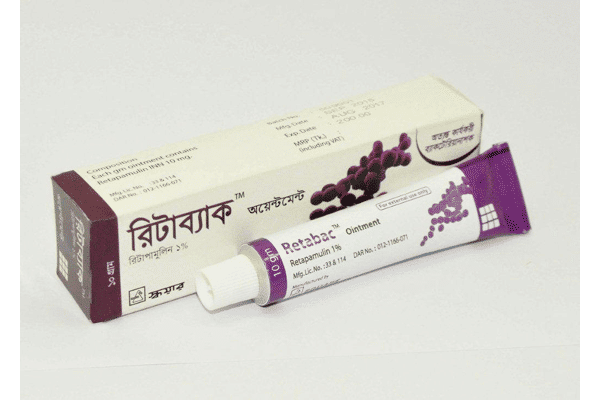
Retabac
 Generic: Retapamulin
 Application:
 Course Duration:
 Alternatives (3)
Cheaper & Alternative Brands (1%)
Same active generic (Retapamulin), same form (Ointment), exact same strength (1%)

Clinical Prescribing Information
Medical monograph and safety information for healthcare professionals & patients.Indications & Clinical Uses
Pamulin ointment is indicated for use in adults and pediatric patients aged 9 months and older for the topical treatment of impetigo (up to 100 cm 2 in total area in adults or 2% total body surface area in pediatric patients aged 9 months or older) due to Staphylococcus aureus (methicillin-susceptible
... Read more
Pamulin ointment is indicated for use in adults and pediatric patients aged 9 months and older for the topical treatment of impetigo (up to 100 cm 2 in total area in adults or 2% total body surface area in pediatric patients aged 9 months or older) due to Staphylococcus aureus (methicillin-susceptible isolates only) or Streptococcus pyogenes. Safety in patients younger than 9 months has not been established. To reduce the development of drug-resistant bacteria and maintain the effectiveness of Pamulin and other antibacterial drugs, Pamulin should be used only to treat or prevent infections that are proven or strongly suspected to be caused by susceptible bacteria.
Dosage & Administration
A thin layer of Topibac should be applied to the affected area (up to 100 cm
2
in total area in adults or 2% total body surface area in pediatric patients aged 9 months or older) twice daily for 5 days. The treated area may be covered with a sterile bandage or gauze dressing if desired.
Contraindications
Contraindicated in patients with hypersensitivity of any ingredient of this preparation.
Side Effects & Adverse Reactions
Adverse effects: Application site irritation (<2% of patients may experience).
Warnings & Precautions
Local Irritation: In the event of sensitization or severe local irritation from Pamulin, usage should be discontinued. Not for Systemic or Mucosal Use: Pamulin is not intended for ingestion or for oral, intranasal, ophthalmic, or intravaginal use.
Pharmacology & Mechanism of Action
Retapamulin selectively inhibits bacterial protein synthesis by interacting at a site on the 50S subunit of the bacterial ribosome through an interaction that is different from that of other antibiotics. This binding site involves ribosomal protein L3 and is in the region of the ribosomal P-site and peptidyl transferase center. By virtue of binding to this site, pleuromutilins inhibit peptidyl transfer, block P-site interactions, and prevent the normal formation of active 50S ribosomal subunits. Retapamulin is bacteriostatic against Staphylococcus aureus and Streptococcus pyogenes at the Retapamulin in vitro minimum inhibitory concentration (MIC) for these organisms.