
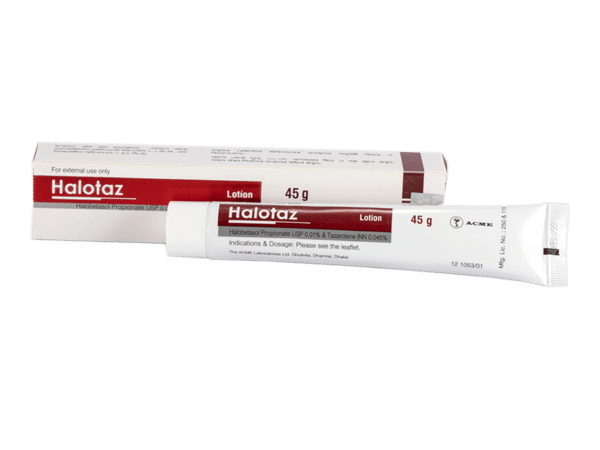
Halotaz
 Generic: Halobetasol Propionate + Tazarotene
 Application:
 Course Duration:
 Alternatives (1)
Cheaper & Alternative Brands (0.01% + 0.045%)
Same active generic (Halobetasol Propionate + Tazarotene), same form (Lotion), exact same strength (0.01% + 0.045%)
Clinical Prescribing Information
Medical monograph and safety information for healthcare professionals & patients.Indications & Clinical Uses
Halotaz lotion is indicated for for the treatment of plaque psoriasis in adults.
Dosage & Administration
Apply a thin layer of Halotaz lotion once daily to cover only affected areas and rub gently. If a bath or shower is taken prior to application, the skin should be dry before applying the lotion. The total dosage should not exceed approximately 50 gm per week because of the potential for the drug to suppress hypothalamic-pituitary-adrenal (HPA) axis. Avoid application of Halotaz lotion from oral, ophthalmic or intravaginal use.
Use in children and adolescents
: Safety and effectiveness of Halotaz lotion in patients under the age of 18 years have not been evaluated.
Contraindications
This lotion is contraindicated in pregnancy.
Side Effects & Adverse Reactions
Common
: Redness, itching, swelling, burning, stinging, folliculitis, atrophy, peeling & rash.
Rare
: Skin ulcer, increased pressure in the eye, increased sensitivity of the skin to the sun & skin discoloration.
Warnings & Precautions
Embryofetal risk
: This lotion contains Tazarotene, which is a teratogenic substance. In females of reproductive potential, obtain a negative pregnancy test within 2 weeks prior to initiating treatment and advice patients to use an effective method of contraception during treatment.
Reversible hypothalamic-pituitary-adrenal (HPA) axis suppression may occur, with the potential for glucocorticosteroid insufficiency during or after treatment.
Systemic effects of topical corticosteroids may also include cushing’s syndrome, hyperglycemia, and glucosuria.
Systemic absorption may require evaluation for HPA axis suppression.
Use of potent corticosteroids on large areas, for prolonged durations, under occlusive dressings, or on an altered skin barrier may increase systemic exposure.
Local Adverse Reactions
: Local adverse reactions may include atrophy, striae, telangiectasias, and folliculitis. If these effects occur, discontinue at least until the integrity of the skin has been restored. This lotion should not be used on eczematous skin, as it may cause severe irritation.
Photosensitivity and Risk for Sunburn
: Avoid exposure to sunlight, sunlamps, and weather extremes. This lotion should be administered with caution if the patient is also taking drugs known to be photosensitizers.
Ophthalmic Adverse Reactions
: Use of topical corticosteroids may increase the risk of posterior subcapsular cataracts and glaucoma. If visual symptoms occur, consider referral to an ophthalmologist.
Pharmacology & Mechanism of Action
Corticosteroids play a role in cellular signaling, immune function, inflammation and protein regulation. However, the precise mechanism of action in plaque psoriasis is unknown. Tazarotene is a retinoid prodrug which is converted to its active form, tazarotenic acid, the carboxylic acid of tazarotene, by deesterification. Tazarotenic acid binds to all three members of the retinoic acid receptor (RAR) family: RARα, RARβ and RARγ, but shows relative selectivity for RARβ, and RARγ and may modify gene expression. The clinical significance of these findings for the treatment of plaque psoriasis is unknown.