
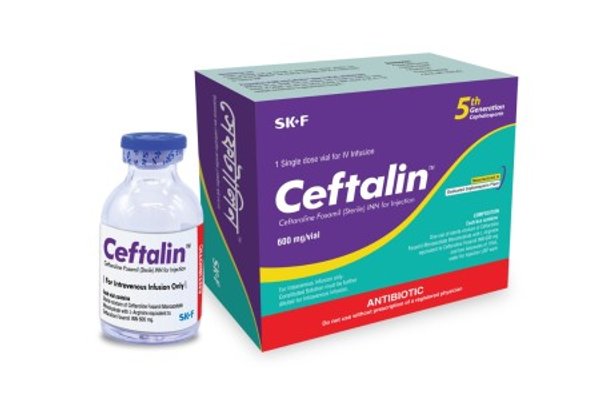
Ceftalin
 Generic: Ceftaroline Fosamil
 Daily Dose:
 Course Duration:
 Alternatives (3)
Cheaper & Alternative Brands (600 mg/vial)
Same active generic (Ceftaroline Fosamil), same form (IV Infusion), exact same strength (600 mg/vial)

Clinical Prescribing Information
Medical monograph and safety information for healthcare professionals & patients.Indications & Clinical Uses
Acute Bacterial Skin and Skin Structure Infections (ABSSSI)
caused by susceptible isolates of the following Gram positive and Gram negative microorganisms- Staphylococcus aureus (including methicillin-susceptible and resistant isolates), Streptococcus pyogenes, Streptococcus agalactiae
... Read more
Acute Bacterial Skin and Skin Structure Infections (ABSSSI)
caused by susceptible isolates of the following Gram positive and Gram negative microorganisms- Staphylococcus aureus (including methicillin-susceptible and resistant isolates), Streptococcus pyogenes, Streptococcus agalactiae, Escherichia coli, Klebsiella pneumoniae and Klebsiella oxytoca.
Community-Acquired Bacterial Pneumonia (CABP)
caused by susceptible isolates of the following Gram positive and Gram negative microorganisms- Streptococcus pneumoniae (including cases with concurrent bacteremia), Staphylococcus aureus, Haemophilus influenzae, Klebsiella pneumoniae, Klebsiella oxytoca and Escherichia coli.
Dosage & Administration
The duration of therapy should be guided by the severity and site of infection and the patient’s clinical and bacteriological progress.
Indications
Age Range
Dosage
Infusion Time
Duration
Acute Bacterial Skin
and Skin Structure Infections
18 years and older
600 mg every 12 hours
5 to 60 minutes
5 to 14 days
≥2 years to <18 years (>33 kg)
600 mg every 12 hours
5 to 60 minutes
5 to 14 days
≥2 years to <18 years (≤33kg)
12 mg/kg every 8 hours
5 to 60 minutes
5 to 14 days
2 months to <2 years
8 mg/kg every 8 hours
5 to 60 minutes
5 to 14 days
0 to <2 months
6 mg/kg every 8 hours
30 to 60 minutes
5 to 14 days
Community
Acquired Bacterial
Pneumonia
18 years and older
600 mg every 12 hours
5 to 60 minutes
5 to 14 days
≥2 years to <18 years (>33 kg)
600 mg every 12 hours
5 to 60 minutes
5 to 14 days
≥2 years to <18 years (≤33kg)
12 mg/kg every 8 hours
5 to 60 minutes
5 to 14 days
2 months to <2 years
8 mg/kg every 8 hours
5 to 60 minutes
5 to 14 days
Contraindications
Hypersensitivity to the active substance or to any of its excipients.
Hypersensitivity to the cephalosporin class of antibacterials.
Immediate and severe hypersensitivity (e.g., anaphylactic reaction) to any other type of beta-lactam antibacterial agent (e.g., penicillins or carbapenems).
Side Effects & Adverse Reactions
The common side effects include diarrhea, nausea, vomiting, abdominal pain, headache, dizziness, rash, pruritus, increased transaminases, phlebitis, pyrexia and infusion site reactions (erythema, phlebitis, pain). The uncommon side effects are anemia, leucopenia, thrombocytopenia, hypersensitivity/anaphylaxis, urticaria, Clostridium difficile colitis, prolonged prothrombin time, increased blood creatinine; and rarely eosinophilia.
Warnings & Precautions
Serious hypersensitivity (anaphylactic) reactions have been reported with beta-lactam antibacterial drugs, including Cefamil-5. If a hypersensitivity reaction occurs, discontinue Cefamil-5. Clostridium difficile-associated diarrhea (CDAD) has been reported with nearly all systemic antibacterial agents, including Cefamil-5. Evaluate if diarrhea occurs.
Neurological adverse reactions have been reported in patients treated with cephalosporins, including Cefamil-5. If neurological adverse reactions occur, consider discontinuing Cefamil-5 or making appropriate dosage adjustments in patients with renal impairment.
If anemia develops during or after therapy, a diagnostic workup for drug-induced hemolytic anemia should be performed and consideration given to discontinuation of Cefamil-5.
Pharmacology & Mechanism of Action
Ceftaroline is a cephalosporin with activity against Gram-positive and Gram-negative bacteria. In vitro studies have shown that ceftaroline is bactericidal, due to inhibition of bacterial cell wall synthesis by binding to penicillin binding proteins (PBPs). Ceftaroline is also active against methicillin-resistant Staphylococcus aureus (MRSA) and penicillin-nonsusceptible Streptococcus pneumoniae (PNSP) due to its affinity for the altered PBPs found in these organisms.