
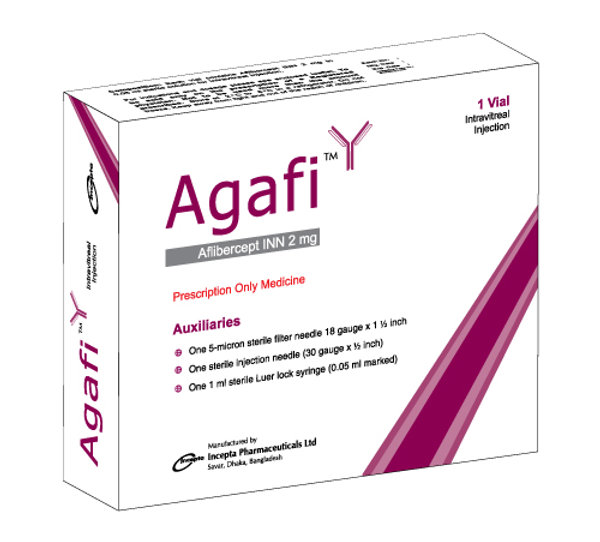
Agafi
 Generic: Aflibercept Intravitreal Injection
 Daily Dose:
 Course Duration:
Cheaper & Alternative Brands (2 mg/0.05 ml)
Same active generic (Aflibercept Intravitreal Injection), same form (Intravitreal Injection), exact same strength (2 mg/0.05 ml)No other brands currently registered with this exact active generic and dosage form.
Clinical Prescribing Information
Medical monograph and safety information for healthcare professionals & patients.Indications & Clinical Uses
Agafi Intravitreal Injection is indicated for adults for the treatment of-
Neovascular (wet) age-related macular degeneration (AMD)
Visual impairment due to macular oedema secondary to retinal vein occlusion (branch RVO or central RVO)
Visual impairment due to diabetic macular oedema (DME)
Visual impairment due to myopic choroidal neovascularisation (myopic CNV)
Contraindications
Hypersensitivity to the active substance aflibercept or to any of the excipients Active or suspected ocular or periocular infection. Active severe intraocular inflammation.
Side Effects & Adverse Reactions
The most common adverse reactions (≥5%) reported in patients receiving Agafi were conjunctival hemorrhage, eye pain, cataract, vitreous detachment, vitreous floaters, retinal pigment epithelial tear and intraocular pressure increased.
Warnings & Precautions
Endophthalmitis, retinal pigment epithelial tear and retinal detachments may occur following intravitreal injections. Patients should be instructed to report any symptoms suggestive of endophthalmitis or retinal detachment without delay and should be managed appropriately.
Increases in intraocular pressure have been seen within 60 minutes of an intravitreal injection.
There is a potential risk of arterial thromboembolic events following intravitreal use of VEGF inhibitors
Pharmacology & Mechanism of Action
Aflibercept is a recombinant fusion protein consisting of portions of human VEGF receptors 1 and 2 extracellular domains fused to the Fc portion of human IgG1 formulated as an iso-osmotic solution for intravitreal administration. Aflibercept is a dimeric glycoprotein with a protein molecular weight of 97 kilodaltons (kDa) and contains glycosylation, constituting an additional 15% of the total molecular mass, resulting in a total molecular weight of 115 kDa. Aflibercept is produced in recombinant Chinese hamster ovary (CHO) cells. Aflibercept acts as a soluble decoy receptor that binds VEGF-A and PlGF, and thereby can inhibit the binding and activation of these cognate VEGF receptors.